
 Bloddy hell, we just can’t get away from “influence,” can we?
Image: Jonathan D. Blundell via Flickr, CC 2.0
Reminds me a little bit of a cheer from my high school days:
Everywhere we go-o-o!
People want to know-ow-ow!
Who we are-are!
We are ______ (insert school/team/whatever of your choosing)
The mighty mighty _______ (see above)
YAY TEAM!!!!!
Or words to that effect.
Ugh.
The tool that’s making the most rounds these days, it seems to me, is Klout.
There have been blog posts ad nauseam by online influencers (and I don’t mean to use that term in a belittling way, so please don’t anyone take it that way) on online tools such as Klout.
If you use HootSuite to manage your social platforms, every time you click on someone’s profile, you’re hit in the face with their Klout score.
And now mainstream media’s getting into the act: I give you last week’s Wall Street Journal article on how certain wannabe cool kids are trying to game the system.
Good grief, after reading that, even my husband, who couldn’t care less about such stuff, asked me if I knew what my Klout score was.
And, then, yesterday’s Inc.com article on how to measure your brand’s online influence.
Now, I have no axe to grind with Klout.
 I’m sure Very Nice People work there.
And I have received my fair share of “influencer perks” from them, some of which I wrote about, though probably not in the way they would have liked, and others I didn’t.
(For a funny look at Klout Perks, check out Olivier Blanchard’s recent post on the swag he’d like.
Maybe I shoulda done something like that. ‘Cos the Sony PSP I received as a promo for “Are We There Yet?” is still sitting in its box.)
But if they claim to be “the standard for influence” (I’m not making that up, that’s their tag line) and people are being influenced to the degree that (quoting from the Inc.com piece) …
“We have people who are getting jobs because of their Klout score,” says [Joe] Fernandez [Klout CEO].
“We have hotels in Vegas that use the Klout score to upgrade rooms, so there’s real value. Klout does actually have real impact on people’s lives.”
… then it seems to me that if they make a prediction of what’s going to happen, based on folks’ Klout scores, it should be at least 75% accurate.
Shouldn’t it?
Let’s take a look.
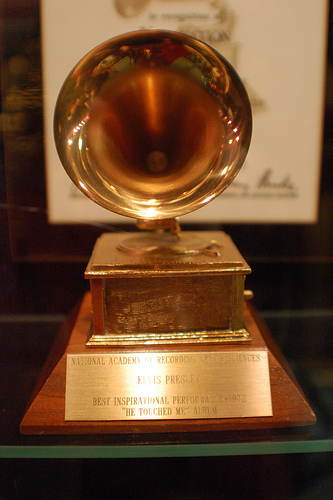
The Grammy Awards aired last weekend.
Klout decided to predict some of the Grammy winners based solely on their Klout score.
Let me repeat that: based solely on their Klout score.
Here’s how that turned out, with what Klout called accurately indented and in bold below:
Record of the Year
Klout prediction: Eminem
Actual winner: Lady Antebellum
Album of the Year
Klout prediction: Lady Gaga
Actual winner: Arcade Fire
Best New Artist
Klout prediction: Justin Bieber
Actual winner: Esperanza Spalding
Best Female Pop Vocal
Klout prediction: Lady Gaga
Actual winner: Lady Gaga
Best Male Pop Vocal
Klout prediction: Bruno Mars
Actual winner: Bruno Mars
Best Metal
Klout prediction: Iron Maiden
Actual winner: Iron Maiden
Best Female R&B Vocal
Klout prediction: Monica
Actual winner: Fantasia
Best Male R&B Vocal
Klout prediction: Usher
Actual winner: Usher
Best Rap Solo
Klout prediction: Kanye West
Actual winner: Eminem
Best Rap Album
Klout prediction: Drake
Actual winner: Eminem
Four out of 10. Four out of 10.
Hmm. I wonder why?
 Could it be that…
… the members of the Academy, who actually vote for the Grammys, don’t really care what people are tweeting about?
Image: Mr. Thomas via Flickr, CC 2.0
… all the people tweeting about and re-tweeting Justin Bieber (Klout score: 100) have little-to-no influence on the people who actually decide who wins the Grammys, i.e. the members of the Academy?
… someone’s Klout score is merely one facet of how influential they might be in real life?
My best guess is that it’s all that, and then some.
I don’t blame anyone for trying to identify influencers and then get them on their side.
But the truth of the matter is that any influence score and influencer outreach must…
… be taken in context
… customized to your organization’s particular needs and circumstances
… be undertaken only once you have clearly identified your ultimate goals.
How do you explain influence?
Justin Goldsborough had a great post yesterday on eight questions to help explain influence.
I left my $0.02 there; I suggest you do so as well.
But my short answer is: influence is when you can get people to actually do something.
It doesn’t matter whether or not they have a gazillion Twitter followers.
It doesn’t matter what their Technorati ranking might or might not be.
It doesn’t matter what their Klout score is.
If you can’t get someone to do something that benefits your organization’s business objectives… they are not an influencer as far as you’re concerned.
In public relations
our clients (or organizations) look to us for strategies on how best to use communication tactics and build relationships that will benefit their business objectives.
Can we please please please not get hung up on discrete scores without looking at the proverbial big picture?
If Klout could get egg on its face with something as silly as Grammy predictions, so could you… with something far worse.


![[EVENT]: PR Hacks for Small Biz (online)](https://shonaliburke.com/wp-content/uploads/2021/06/FB-Ad-1200x800-01-01-01-Copy-500x383.jpeg)





[…] in case I haven’t hammered it in […]
[…] written before about why Klout should not be a synonym for influence, and on influence in public relations and social media … so I’m sorry if I’m […]
[…] Go all the way down to the bottom and click on “1 Answer Collapsed”. I posted a link to an article I thought applicable followed by QFT. Someone obviously didn’t find my sense of […]
[…] Lors des Grammys 2011, Klout s’est totalement planté dans ses prévisions. Dans son billet Why Klout Should Not Be A Synonym For Influence, Shonali Burke fait un tableau comparatif des prédictions de Klout vs les vrais résultats. Elle […]
[…] in case I haven’t hammered it in […]
The Grammy’s angle is interesting. I mean, look at Justin Bieber. He has a rare, and perfect, Klout score of 100. Yet he lost out to someone that most people never heard about. Go figure, eh?
When I wrote my post last week about the “mean girl” mentaility creeping into Klout, the company’s Chief Product Officer chimed in to say that scores weren’t determined by number of followers. I get that and I, too, subscribe to the quality over quantity theory. However, too many people are manipulating the system.
Technology is great, but as long as people have the power to skew the information, we’ll always have “mean girls” who try to get ahead at the expense of others.
It’s an interesting prediciment and here’s the ironic part. WE, the active social media users, are the ones engaging in this discussion. NOT, the companies who are using Klout to pimp their products. Should be very interesting to see how things play out this year.
Amber Avines @WordsDoneWrite
@WordsDoneWrite Hey, thanks so much for commenting, Amber! Yes – that was my point exactly in using the Grammy example. Frankly, I was surprised Klout would set itself up like that.
Well, at least you got Klout’s CPO to comment, and @ginidietrich got a comment from joe fernandez on her post. So far no one from Klout has even acknowledged this one, let alone commented. Guess my Klout isn’t that clouty… or their listening platform leaves something to be desired. :p
@Shonali @ginidietrich I bet the folks at Klout are overwhelmed at the number of people writing about them this month. I was completely surprised to get the comment and am not sure how he even heard of my post. As for Gini, well, I’m sure Joe reads her blog all the time since she’s such a rockstar!
Anyway, I’m pleased that Lisa Thorell told me about your post. Glad to meet you, Shonali!
@WordsDoneWrite I’m very glad to meet you too. :) Yes, @ginidietrich is one of the “real” rock stars, IMHO.
Klout… well, it goes with the territory, doesn’t it? And they’ve set themselves up for it, in a way. But I’m told they handle criticism well, even though I haven’t really had first-hand experience of that… oh, actually, I have. When I wrote about the LoneStar/FOX promo, Megan did post a comment.
Nicely written. I arrogantly dismissed Klout’s validity last year when the LA-Toronto Virgin Air promotion was getting Toronto’s Twitterati all frothy with the promise of a free flight to introduce the route. While it struck me as a popularity contest vs. an identifier of influence (several people won who likely have never flown on a business trip anywhere, let alone to LA) I entered myself to see how it would work. I won the free flight, but never redeemed it. Lots of people with good Klout scores got free flights, took them, tweeted about it, etc. Were they the right people? Were they hardcore business travelers who’d appreciate the difference between an Air Canada cattle car and the coolness of a Virgin flight? I’d hazard a guess and say most weren’t. Heck, I’ve been a light business traveller for 19 years and I haven’t gone to LA…yet.
I do have to add a proviso. It is entirely possible this was just a way for Virgin to test the social media waters to see what’s possible. I wasn’t involved in the strategy or execution, so I have know way of really knowing what the intent was. At the very least, it was an interesting experiment. Likely pretty easy and cheap to execute and probably resulted in a lot of insights and data that can be used in the future. Full marks for giving something untradtitional a shot. I’m all about test & learn.
But as a way to sample people who have “influence” I’m not entirely sure it resulted in the success that Klout wanted to see. Virgin closed its LA-Toronto route last month. http://www.vancouversun.com/travel/Virgin+America+drop+Toronto+route/4148876/story.html
@DoctorJones Thanks, Doc. :p I remember the furor (sp?) over the LA-Toronto Virgin/Klout promotion – wasn’t that the first such promo, or at least one of them?
I think you’re absolutely right that this may have been a way for Virgin to run some tests and, yes, kudos to them for trying – as also to FOX re: the LoneStar promo (I signed up for that, wrote more about the marketing than the show, thought the show sucked, said so, was told I was an idiot… and the show got pulled), Pop Chips (another promo I was part of but didn’t write/tweet about) as well as the recent “Are We There Yet?” promo (Sony PSP is still in its box). These are all organizations with money to spend and yes, at least they are trying something new. But I’m pretty sure they are also trying a whole bunch of other things and not getting caught up in the “one-score-shop” that so many others are. That latter is what really frightens me.
On the Grammy’s:
If Twitter and Klout measure public sentiment, what relation does that have to Grammy picks? Only members of the academy vote on Grammy nominees. By “members” I mean rich, famous, insulated members of the music community who are completely out of touch with the public. If you didn’t realize that the music industry was out of touch with the public, you’ve never watch MTV Cribs or listened to the radio.
On Klout and Influencers:
Several reports have been sent around that show that “influencers” aren’t even that influential. Once major brands and personalities began to infiltrate Twitter, Facebook and other social networks, THEY became the influencers. Who has more influence when it comes to carbonated beverages on Facebook: a user with thousands of friends or Coke with 22 million+ fans? THe same goes for Twitter, et al.
This is not to say that social networks and their members are not important, quite the opposite, but it does mean that you’re better off targeting a large group of medium users than a few users with large followings.
@mdurwin The reason I used that Grammy example was to illustrate how when even Klout uses its own system to pick winners, it failed, because it went purely by the nominees’ scores. As to whether the music industry is completely out of touch with the public, that may be, but that doesn’t mean Klout scores are representative of overall online influencers, because it only seems to track a couple of touchpoints – and certainly not “the public.” many of whom are still not using Twitter as much as folks like you and I do.
As to Coke v. the user: it depends on what change they effect. In fact, I think people would be more likely to listen to a friend’s opinions on carbonated beverages than the brand’s official representative… because, really, how likely is the brand to give you an honest opinion v. try to get you to buy more product? Hence the emphasis brands put on reaching people who are willing to talk about their experiences and opinions, thus generating action, or change in some way (e.g. changed thinking).
I personally think a hybrid approach is good. Don’t ignore the “biggies,” because you never know what might come of reaching out to them, but also including medium users, as you put it, should definitely be part of the plan.
Good post Jonathan, especially relevant as some businesses are starting to look at influence scores and ‘reward’ those who score highly. I wrote a similarly themed post over on Econsultancy.com a while ago ( why Klout doesn’t count -putting social influence in context: http://ecly.co/ecSWt9 ) which you might find interesting, basically I ran some simple tests and found Klout to be pretty innacurate in general,.
it’s my firm belief that too many people are still treating social as a numbers game, when they should be concentrating purely on relevance to the audience.
@MattOwen “Jonathan”? Oh, please don’t re-christen me. :p
Seriously, though – thank you. And what a great post and experiment you ran, Matt. Thanks so much for sharing that, as well as for stopping by.
@Shonali lol, I seriously apologise -obviously one of the perils of having several tabs open at once! A really useful post, I believe that Klout’s measurement methods are improving quickly, and they will ultimately be able to avoid valuable information, but it’s dangerous for companies to put too much faith in numbers just yet, especially when searching for measurable ROI -excellent post as well!
@MattOwen LOL, don’t worry about it. Thanks again for stopping by!
I’ve delayed comments because of my covert-now-overt quest to beat shonali ‘s Klout score. This takes a lotta strategic tweeting ( …feeble attempt at Klout humor).
…The conversation has been engrossing here. The business insight and stance regarding true, blue influence is fantastic, well-rounded. I interact with Klout on a more individual level vs organizational; so it’s been riveting reading opinion and trial-error approaches these past months.
This all brings to mind a recent discussion with a friend and colleague. He shared how someone called him an influencer, specifically by ‘an online influencer’ that my friend held in high regard. This compliment surprised him (my friend) and differed from his self-perception. As much as he valued the other influencer’s opinion, he was unsettled and asked me questions like: “So what does this mean? How do I act? Am I good enough to be paid this compliment? It’s a good thing, right?”
I wasn’t sure how to respond but his nervous reaction was a concern. The influencer label was distracting him from his normal level of confidence and clarity of mind. I replied with: “It’s a nice psychological eff-job. Ignore it and do your thing.”
I see how it was a well-intended compliment for my buddy to experience; he’s effective and good hearted. I don’t mean to poopoo that. And certainly, being well regarded would be a wonderful advantage. That compliment though tapped into what is a deep and fragile psychological place in we humans. Is tapping into that a reasonable starting place for making a credible online influence tool? …or is the question inevitable vs reasonable? I don’t know. But it is a hope Klout (& the industry) tenaciously moves toward a more comprehensive, transparent metric in light of the sphere from which it draws ‘data.’
Thanks @Shonali for again writing a post that evokes as much psychological intrigue as it does business reflection.
@Jillfoster Yay, you commented!
All I can say is I am in VIOLENT agreement with you, Jill!
[…] didn’t really want to add to the conversation about Klout. Shonali Burke did a nice analysis, Mark Schaefer created quite the conversation, Trey Pennington discussed why it’s necessary, […]
Excellent post. And yes- Far worse than failing on predictive validity with Grammy awards, a
<a href=”http://bit.ly/gsq3hw”> number of people </a>see Klout fundamentally affecting the style of our online interactions moving forward.
@LisaThorell Ok, many of the tweets in that post from fans of Klout are scary. Very scary.
@JGoldsborough @LisaThorell Absolutely. Think back to college. We all knew that some reverse-engineering of how the grades/scores were computed was necessary to get an “A”. So here we are with Klout, a grade. Should we be surprised at people’s change in behavior in terms of priorities of their follows, retweets?
@LisaThorell @JGoldsborough This really is frightening and, IMHO, despicable, if that’s what people are doing. I forget who, but someone on Twitter pointed me to the original “Mean Girls” post that this one drew from. At the time I found it hard to believe that anyone would actually go to such lengths to “protect” or improve their Klout score. I guess not.
@Shonali @JGoldsborough FYI – the original “Kloutgate: Battle Between Means Girls and Influencers” is from Amber Avine http://wordsdonewrite.blogspot.com/2011/02/kloutgate-battle-between-mean-girls-and.html – fab post.
@LisaThorell @JGoldsborough Yea, that’s the one.
@Shonali @LisaThorell @JGoldsborough Thank you guys for reading my “Mean Girls” post about Klout last week (and thanks, Lisa!). I’m sure this issue will only get more complicated and controversial with time. Should be interesting to follow, though.
Amber Avines
@Shonali@LisaThorell@JGoldsborough
Thank you guys for reading my “Mean Girls” post about Klout last week (and thanks, Lisa!). I’m sure this issue will only get more complicated and controversial with time. However, if the right tweaks are made, it might be a whole new ballgame out there. Should be interesting to follow, though.
Amber Avines
Great Scott! You’ve opened up a real can of worms here.
Is it possible that none of this matters at all? Influence surely emerges from other places than social media. Perhaps people generate awareness and understanding of their personal brands on social media, but does their influence emerge from social media, or from their own existence? Chris Brogan and Brian Solis are published authors, speakers and business owners — I have to wonder whether influence comes from that triple threat than from their blogs and tweets… Otherwise, Cogito Ergo Tweet — Tweet Ergo Sum, eh?
@commammo Heh! So… yea, it’s certainly possible that none of this matters. But, when people start getting job offers or not based on their scores, then it does matter, doesn’t it? And, for the record, I have neither been offered nor rejected for jobs/work because of my Klout score or lack thereof. :p
[…] This post was mentioned on Twitter by Mark Schaefer, J. Martin Poston. J. Martin Poston said: RT @markwschaefer Hey markwschaefer, just mentioned you in my comment on "Why Klout Should Not Be A Synonym For Influence" http://fyre.it/sP […]
this discussion is going on simultaniously all over the web, which means Klout has done a great job of claiming this space. That said, Klout seems to be a proxy for reach, which is by no means the same thing as influence…nor is it even the goal of many programs. In the b-to-b world, for instance, a qualified audience would trump a mass audience every time. so, Kredit to Klout for getting on the Kultural radar so fast — clearly they’ve touched a nerve, but I’ve yet to see a Kompelling use for it as a business tool. The search for great metrics goes on.
@jpundyk
@jpundyk I absolutely agree with you, about Klout having Klaimed this space, or at least having an extremely prominent position in it. Very good point about the Kwalified audience (hey, you started it with the Ks!) – I still think that should be what people should look at. Certainly, don’t discount the mass audience, but if a qualified audience is not a part of the strategy, then it makes everything that much harder.
@Shonali I surrender on the “Ks”!
not trying to pick on Klout. I’m sure it has its place. Just think the hype among insiders far outsrips real world awareness/interest/action. (Quora is another example. ask a “civilian” if they ever heard of it.)
one quick, easy example: Right now, if you sell servers, who do you want to reach: somebody with a big K score and no budget or somebody with a big budget and a low K score? Mass audience is a siren song. It requires real discipline and self-knowledge to weigh its value in the context of your goals. Same logic applies for valuing any measure of influence. Influence over who is a key question. Maybe Klout and others will evolve to offer segmented scores. Assuming the methodology is sound (a big assumption), then they start to get interesting.
Love that this topic is so alive. speaks to a real need.
@jpundyk LOL!
I’m with you; I really have nothing against Klout or any of the people who work there, but the hype does not live up to the promise, and the promise does not live up to the reality. On the other hand, many tech/SM products and services start off like this – by creating hype among the tech/geeky crowd, and then that has a ripple effect… like Twitter. I’m yet to use Quora actively, btw.
Completely agree on the point of context. That was why I wrote this earlier: https://shonaliburke.com/2011/01/11/on-influence-in-public-relations-and-social-media/
Alright, alright! I give! I blogged about this. It airs on Tuesday. I wasn’t going to blog about it, but you and markwschaefer got me all riled up (I agree with you). I think if they figure out how to target and segment, they’ll make a gazillion dollars. Until then, it’s pretty disconcerting to me that big, global companies are sending people with high Klout scores stuff we don’t want or need.
@ginidietrich markwschaefer I don’t think its a winner even if they figure it out. I think we are way over emphasizing online to a few magnitudes higher than the real influence on our lives. Only 40% of people surveyed by th Center for Media Research (I have to find it and I will) said they at least ONCE took a social connection review and tried something. So again it comes down to goals.
But we all know Mark and @Shonali like to stir the shit up =)
@ginidietrich markwschaefer I’ll take any stuff you don;t want. I’m a Klout whore. Seriously. I’ll sell it on eBay or something. Official Klout graft. I haven’t recevied a damn thing yet. C’mon Fernandez throw me a bone.
@ginidietrich markwschaefer Check out the post @LisaThorell shared. They may make a million dollars anyway by capitalizing on peoples’ insecurities and desires to be popular.
@HowieSPM “Stir the shit up”? Never! @ginidietrich markwschaefer
@HowieSPM I think they actually do have something that could be huge, like@ginidietrich does. My problem with it is that right now it’s not broad enough, yet people are making it out to be so.
I have no problem with Klout and there are some truly incredible people working there, but their impact and significance was diminished for me when a friend of mine had the same Klout score as Oprah Winfrey. In their defense, I don’t fully understand what exactly they are measuring and why they are measuring it, but only about 50 people in the WORLD have the influence that Oprah Winfrey does. And as awesome as said friend is, she doesn’t have the pull that Oprah does.
That was the point where I said, “I’ll come back in a few months or a year when the algorithms are more fine-tuned for a true measure of influence.”
Like you alluded to, shonali , Tweets don’t mean anything unless something significant happens from them. See Ashton Kutcher, then compare the results of his tweets to those of your crazed Beiber fan with the same or higher Klout score, and you’ll realize where the disparity lies.
@jmatthicks The old Oprah argument. Klout is a proxy for influence on Twitter. Oprah doesn’t tweet. So on Twitter, yeah, your friend is probably more influential. It’s really that simple. If Oprah started tweeting then your frined would be toast. Klout is not an absolute measure of anything, it’s a small indicator of a small slice of the world where Justin Bieber is king.
@markwschaefer “The old Oprah argument. Klout is a proxy for influence on Twitter. Oprah doesn’t tweet.”
What? oprah does Tweet. She has over 5,000,000 followers.(http://twitter.com/#!/Oprah). She may not Tweet every 1 hour like 90% of us “social media disciples” do, but she has a Twitter presence that, if measured “pound for pound” per Tweet, carrys exponentially more influence than any of us ever will. There’s no way around that.
“Klout is not an absolute measure of anything, it’s a small indicator of a small slice of the world where Justin Bieber is king.”
I agree, which is where my “issue” with Klout lies and was the main point of my comment: I like their concept, but I’ll become a “Belieber” (I mean, believer! ;) when a more accurate influence algorithm is implemented.
@markwschaefer @jmatthicks The other problem is that there’s no such thing as universal influence. Even Oprah or Beiber are not influential to all audiences. I don’t give a rip about either and wouldn’t do anything because of something either of them tweeted. I’m sure I’m not the only one.
@JGoldsborough @markwschaefer @jmatthicks depends what they’re talking about. we compartmentalize our experts…trust so and so for baseball and somebody else for stock market advise but not vice-versa. trust and credibility does not cross categories. there’s no one-size-fits all influencer (except for those who you don’t trust for anything!)
@jmatthicks “One look at you… now I’m a Belieber…” :p. Couldn’t resist that one. :p
I have no problem with Klout and there are some incredible people working there, but their impact and significance was diminished for me when a friend of mine had the same Klout score as Oprah Winfrey. In their defense, I don’t fully understand what exactly they are measuring and why they are measuring it, but only about 50 people in the WORLD have the influence that Oprah Winfrey does. And as awesome as said friend is, she does have the pull that Oprah does.
That was the point where I said, “I’ll come back in a few months or a year when the algorithms are more fine-tuned for a true measure of influence.”
Like you alluded to, shonali , Tweets don’t mean anything unless something significant happens from them. See Ashton Kutcher, then compare the results of his tweets to those of your crazed Beiber fan with the same or higher Klout score, and you’ll realize where the disparity lies.
In defence of Klout and its Grammy predictions, I don’t think they did any better or worse than most of the flesh-and-blood pronosticators I read. Guessing four out of 10 Grammy winners means only that trying to predict any award winner is largely a mug’s game. I mean, no-one in the U.S. predicted our great Canadoian indie band Arcade Fire would prevail over Lady Gaga!
That being said, I don’t disagree that a single measurement of how popular you are on a single social media channel ought to be any kind of reliable proxy for how influential you might be in any given situation.
@FrancisMoran “A mug’s game,” LOL.
What was silly about this post was that – even if it was meant to be fun and get attention because of the Grammys – was that they used their own system as a yardstick. I suppose it’s easy enough to cop out and say, “Oh well, it was just fun,” if they wanted to, but my point is, when their entire product is based on how relevant their score is, the post was a prime example of why it’s not… at least, not as a discrete number. I don’t think it was a very smart thing for them to do. Just MHO.
Thanks for stopping by – I really appreciate it!
I give Klout credit. The CEO Joe Fernandez was in a SM chat on twitter just getting hammered yet he glaldy answered questions. They have done a great job of branding. And kudos for them.
My issue is that Social Media is not very viral. Very few things get pushed around on a large scale. We see so little of our streams. I was realizing today how many accounts I follow with big Klout that I followed early on I never see any tweets of theirs, yet they still tweet a lot. When BP was happening it wasn’t the same tweet going around we all were tweeting. And as I had mentioned to @ginidietrich recently when I looked at the Edelman Trust rating it was based on RT’s. So if I tweeted $10 off at this store and 1000 people ran and bought something, but no one retweeted me, my influence was zero! And with most Facebook communication private and only 10mil US users of Twitter each (if that) I don’t understand the value. We have 250mil consumers. We talk way more via SMS, Email, talking live in person or on the phone or from watching TV etc.
So the big problem is they are purposefully confusing Real Life Influence with Online Influence. Two hugely different things. And for each company your need is different. The NY Times wants their article linked and shared. Macy’s wants purchases. One wants online influence much more than the other.
@HowieSPM From all that I’ve read of Joe Fernandez he seems like a decent guy, and is clearly smart. And he seems to handle fire very gracefully.
The problem is exactly what you say: online influence and real life influence are two different things. Moreover, the way Klout currently positions itself, Twitter activity seems to be the prime driving factor. They say they have changed their algorithm to improve it, but that needs to be reflected on one’s profile as well.
@Shonali @HowieSPM There is a post on Social CMO that treypennington wrote that talks about how nice Joe is and why Klout is necessary. I also love that he handles fire very gracefully. And we all want to work with nice people. But until they figure out WHERE people have influence, it’s all a big joke.
@HowieSPM @ginidietrich Who is confusing online influence with offline influence? I don;t think Klout would claim any such thing Howie. Are they confusing it or are you? : )
@markwschaefer When Klout says they’re “the standard for influence,” doesn’t that pretty much contribute to the confusion? @HowieSPM @ginidietrich I too have heard about how nice Joe is, and kudos to him and his team for that; they all seem to work very hard. But they also seem to be ok with the way these scores are, IMHO, being misused at times – to offer jobs, etc., as has been reported. I’d really like to see them take a stand, as Twitalyzer’s Eric Peterson did, when he made it clear that this is NOT the way any scores should be used. If they’re not in context, they’re nothing.
@ginidietrich @Shonali @HowieSPM treypennington Thank you for the shout out. Loved the back-and-forth comments around the blogs as a result of those infamous “4 keys to increasing your Klout score” and the necessity of Klout. Klout is indeed a weak tool, but the tool is not really the problem. The real tragedy seems to be those overwhelmed, understaffed marketing directors who say, “Thank God, now there’s a two-digit score for influence so I can get my boss off my back about measurement, and oh wow, I can just BUY Klout’s top influencers and I can quit trying to figure this stuff out for myself. Whew.”
@treypennington @Shonali Unfortunately you’re right, Trey. There is a NY Times blog post on this very idea (my blood is boiling)…that PR and marketing pros are lazy, can’t quantify their results, and use the easy way out. Klout is just another tool that allows our industry to continue being lazy. It’s the new way of sending 2,000 news releases to reporters in the hopes of getting 200 stories.
@treypennington I was just going to say that and @ginidietrich beat me to it (so what else is new? :p). This is why I am so irriitated with the MSM coverage of tools like Klout. They boil them down for the lowest common denominator, without – IMHO – thinking of the impact it’s going to have in the real world.
@Shonali @treypennington @ginidietrich Again absolutely agreed -doubly perplexing as surely MSM/NY Times etc should be ahead of the curve when it comes to sentiment analysis and audience targeting, it seems bizarre that large media outlets are so willing to simplify and take figures at face value when they should be dynamically working towards genuine cross-channel marcoms integration. Still, seeing some really interesting developments in the field of sentiment analysis lately so with luck things will improve in the near future.
@ginidietrich @treypennington @Shonali do you know how much money has been made on laziness? In my opinion all the digital ad networks have forged a mint of money this way. Buying email and address lists to send out mass shotgun approach marketing. It is ingrained in marketing for sure. How many Twitter accounts have in their profile ‘get rich with Twitter’ tag lines? Because it’s so easy everyone can do it.
@MattOwen @treypennington @ginidietrich It *is* bizarre, because they definitely have smart people working in their marketing departments. But I guess those people don’t write the stories.. the latter are looking for traffic & clicks, so the more salacious or spicy a story, the better.
@HowieSPM Do I know? No, but I can well believe it. @ginidietrich @treypennington
Oh, Klout. Klout, Klout, Klout. I admire the work Joe and team are tryig to do. In fact, we have discussed using Klout as one of many factors we consider when researching influencers for our clients — the same way we use rank and authoirty from Technorati.
But somone upgrading your hotel room has nothing to do with if you are influential. It’s a freakin’ marketing promotion. End of story. There is a qualitative metric that has to be considered in any influencer evaluation we do. In our FH process, we call it relevancy. I like to call it knowledge of the relationship. Whatever we call it, the client and those who work for the client should have an understanding of the business and what targets make sense to achieve the business objectives.
Not everyone is going to have that information. So there is a “because I’m close to the situation and know the inside baseball” metric we must consider. What if Klout gave me a “starter” score, but allowed me to move it up and down within my own client bucket based on what said client brand needs to achieve its objectives. That might be more intriguing to me. Good, smart stuff as always, Shonali. Cheers!
@JGoldsborough “… we have discussed using Klout as one of many factors we consider when researching influencers for our clients” – Bingo. I think that’s a smart thing to do, Justin. My point is that exactly – that it should be ONE factor, and not the ONLY factor, which is what I think far too many people take it as.
Shonali, thanks for a thoughtful post. Tools like Klout are just that – tools – to be used by people, not an end in themselves. Without judgment, context, interpretation and humans adding value, they’re no better than a vacuum cleaner. Mind you, Watson was pretty damn impressive on Jeopardy wasn’t he?
@ThePRCoach I think this is a first, for you to comment on WUL? Thank you!
Yea – how about that Watson, eh?
@Shonali – hear, hear. As I wrote, http://bit.ly/commammo11-3, there’s not a shred of evidence that supports the idea that you can gauge influence based on analyzing the twitter stream. Duncan Watts of Yahoo! tried — it’s situational, specific, not general and easily calculated, despite what many companies will aver. It’s not going to scale in the same way that other means of determining influence will. Klout is trying, indeed, as @judyshapiro says, but until there’s independent analysis of their calculations and models, it’ll be a well-intentioned waste of time. Thanks for nudging…
commammo
@commammo I love it when you stop by, Sean. Thank you! For the record, I don’t have anything against Klout. But folks have got to stop treating it as the second coming at least until they can show that the scores actually have relevance in the offline world.
Your question is non starter because Klout is to social media influence what credit scores do for banks.
Like in credit scores — they can be wrong and they can misinterpreted when taken out of context. Take the case of someone who suffered a medical injury and as a result their credit score suffers due to overwhelming bills.
The point is that once social media currency became as asset – people will try to assign hierarchical credit structure.
When one considers the other “grading” tools – most were pure shams. This one is working hard to be credible … It’s not perfect in any way – but I appreciate the integrity they try to inject into the system. This kind of grading system will not go away – The question is how it becomes productive…
Judy Shapiro
@judyshapiro My question… oh, you mean the one at the beginning? That was supposed to be more rhetorical than anything else.
With all due respect, it’s saying things like “Klout is to social media influence what credit scores do for banks” that compounds this misperception. I agree that people are going to try to rank, etc. – and so will companies – no argument there. But there have got to be more factors than simply how active someone is on Twitter for any measure to be a somewhat accurate representation of their overall online influence.
Of course Klout isn’t perfect, I doubt any scoring system is. I can’t really see how they are trying harder to be credible than any other system. IMHO Twitalyzer is doing a better job of that. I can’t say whether or not other tools are “pure shams;” my personal view is that if Klout is really going to be what it says it is, i.e. “the standard of influence,” then it has to up its game to more than counting how many Twitter followers and possibly Facebook friends someone has, and their activity therein.
@Shonali @judyshapiro
It’s hard for a headline to be “rhetorical” especially since you have your conclusion in the question :).
Aside from this – I agree wiht you on this point: “There have got to be more factors than simply how active someone is on Twitter for any measure to be a somewhat accurate representation of their overall online influence.”
And that is where a bit of homework helps since Klout is not a single metric toy of just Twitter. If you look at their methods – you will see that is a robust multi-dimensional system. For more info: http://klout.com/blog/2011/02/taking-klout-scoring-to-the-next-level/
For the record – I have no association (biz or personal) with Klout. But I do see the seeds of an important trend – the needs to create systems that are useful and credible. Klout is giving it the best try I have seen yet amongst all the players out there.
Judy
@judyshapiro @Shonali Hi There – I’ll agree they’re making an attempt, but it’s anyone’s guess what the attempt is based upon. The comments on the Klout post are pretty revealing — it’s a black box, and every black box lacks independent review, so is suspect. I believe in capitalism and making money in business. I just am suspicious of a methodology that doesnt appear to have any basis in research beyond the surface metrics.
@judyshapiro “It’s hard for a headline to be “rhetorical” especially since you have your conclusion in the question :).”
Not really. That’s pretty much what a rhetorical question is supposed to be. :)
Beileve it or not, Judy, I did see that post. It still doesn’t tell you how they’re computing the score or making their algorithm better. So until and unless they start incorporating some of these into what one actually sees when one views the score, the impression people are left with is that it’s pretty much what you do on Twitter that leads to it.
I don’t blame them for trying; I applaud them for doing so, as well as most other companies who are trying to make sense of this. There is clearly a demand for it, and that’s not going away any time soon. What worries me is that because of the way it’s framed, people latch onto the score as the be all and end all, without looking at the larger picture.
@Shonali @judyshapiro
A credit rating is a measure for a single purpose: Is this person likely to repay a loan. Many different measures go into play, but there is a pretty clear understanding of how the score is developed and what it’s for.
The problem I have with Klout is two-fold. First is a matter of semantics. I think most of us would agree that what Klout measures is not ‘influence’ as most of us would define it. Rebroadcast score? Twitter echo? Those may be better titles for what I can see the Klout algorithm spitting out.
The second is that we are trying to shoe-horn one number into giving the answer for very different objectives. Are we trying to build awareness? Are we looking to establish trust amongst a stake-holder group? Are we hoping to demonstrate superiority of one product over another? Different goals will require different approaches. No single scoring system will be able to float the right person for the right task to the top. Justin Bieber may have a score of 100 and I may have a score of 48 but neither of our scores will help you if you’re trying to sell toilet bowls.
However I fear we opt for the quick and easy number rather than look for the right number. When I hear tell of HR departments requiring a Klout score or of marketing people interweaving Klout into their tactic I see a laziness that serves only to entrench a good early attempt as the final destination.
My concerns of Klout would be largely aswayed if the company were to push proper use-cases for their scoring as opposed to promoting it as a catch-all for everything and anything. We wouldn’t dream of using people’s credit rating scores to determine how they fit into our marketing mix. Let’s not make the mistake of turning Klout into a KPI for all seasons.
@judyshapiro A rational assessment. Thank you.
@theelusivefish That’s exactly it. People take the number as their answer to everything. It’s not.
“KPI for all seasons.” I love that!
Thanks Shonali for a thought provoking post. I was down in the link tunnel reading some of the other stories that helped bring yours together (Justin Goldsborough and from there Todd Defren)…
I think the thing that annoys me most about Klout (and other single point indicators) is that it just misses so many things. First it creates mini competitions, I know started querying some of my friends, pals and others to see what their scores look like for comparison. In some cases I was like “What?” And all that gets is the feeling that “we’re not like the Joneses…”
As you pointed out and Justin as well, that influence is comprised of a number of things, some that are intangible. It’s also important to remember that those defining how to measure “influence” is heavily weighted by their own definition of what “influence” at the moment, it’s just human nature. While points of measurement are helpful, they need to be brought into context, especially for those who are new to how social media really works…beyond the hype.
Some folks live and breathe in smaller communities that may not be mainstream. They could be very influential in those circles and help bring about needed change, but if compared to a Justin Bieber ranking, they’ll be dwarfed. It’s all relative, and I believe every person has value to the communiies they serve and it would be very challenging to come up with a single score ranking based on that.
Influence is about being able to bring about changes in others – whether it’s change in thought or actions, small or large. Much is in the subleties of “how” influencers go about doing that… via tweets, wriitng books or compelling blog posts… is different and cannot be distilled down to any one thing, and affects their “audience” in their own personal way.
Thanks again, good thinking for a Friday morning!
@julianng You expressed many of my concerns with such scores. We don’t know how they’re tabulated because of the “secret algorithm,” and people tend to make snap decisions based on what someone’s score is or isn’t. And when people’s jobs start depending on how high their Klout score is… well, that’s a very big problem.
For one, their Klout score, which, as far as I can tell and as maggielmcg pointed out, is based on primarily their Twitter activity, possibly to some extent Facebook. Someone could be very good at their job and just not that into Twitter, or tweet relatively scarcely, or be new to it while being very respected offline. IMHO, it has relatively little bearing on how someone would actually do that job.
The second thing, related to this, is that just because someone’s Klout score might be high, it doesn’t mean that person is going to use their “influence” to benefit the business. If my clients hired me based only on my Klout score, they would be sorely disappointed, because while I do tweet client-related stuff occasionally, it really is occasional. What should matter is how well I can do the work they’ve entrusted me with, and how I can help them meet their business objectives through that work.
I really like what you said about influence is being able to bring about changes in others. That’s exactly it.
Thanks for commenting, Julia, I appreciate it!
[…] This post was mentioned on Twitter by Shonali Burke, Alex Greenwood. Alex Greenwood said: RT @shonali: New post: why Klout shouldn't be a synonym for influence: http://ow.ly/3YFi9 #pr #socialmedia h/t @JGoldsborough […]