Carry On Kofta
I “borrowed” the title for this recipe post from Shashi Bellamkonda‘s Carry On Curry, because I knew he wouldn’t mind (you don’t, right, Shashi?). If you haven’t read CoC, you should check it out, it’s great fun and extremely valuable for foodies in the DC metro area.
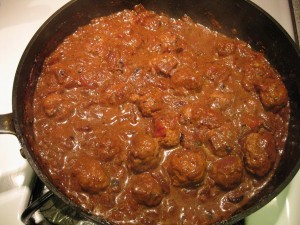
Koftas are basically the Indian version of meatballs. Just like the feringhis, we rarely eat them without some kind of gravy (or curry, which means many more things to us than a spice or herb). But we’ll often pair them with a vegetable, dal and rice and/or rotis (tortillas are an ok substitute) to make a really hearty meal.
Here’s my recipe for kofta curry, a classic Indian comfort food.
Ingredients
Koftas: 1 lb. ground lean turkey (or meat of your choice); ½ cup chopped cilantro; 1 tsp cumin seeds; ¼ tsp turmeric powder; ¼ tsp salt; pinch chilli pepper; ½ tsp ginger paste; ½ tsp coriander powder. Enough oil to deep fry the koftas.
Curry (gravy): 1 tbsp cooking oil; 2 red onions, chopped; 1 cup plain non-fat yogurt, beaten with a spoon until it’s smooth; ½ tsp turmeric powder; 1 tsp garam masala; 1 can plain diced tomatoes (or 1-2 fresh tomatoes, diced);¼ tsp chilli powder; ½ tsp salt (or to taste).
Recipe
Mix all the ingredients for the koftas well and make them into fairly small balls. Heat enough oil to fry them in a large pan. When oil is smoking, drop them in and fry them until well-cooked (this will happen fairly quickly if you use turkey or chicken). Set aside, using paper towels to drain excess oil.
In a pan (or you can use the same one, just clean it up) heat cooking oil. Add chopped onions and brown over medium-high heat, stirring often (otherwise they’ll burn). Once onions are browned, add powdered spices and stir for a couple of minutes. Reduce heat to medium-low and add yogurt, mixing until well blended. Finally, add tomatoes and cover, stirring occasionally, until tomatoes are cooked and you have a nice thick gravy.
Once the gravy is at the consistency you like, add meatballs and stir for a few minutes. Voilà - you’ve just made kofta curry!
Notes: If you’re concerned about the amount of oil involved in deep-frying the meatballs, you could try brushing the meatballs lightly with oil and then baking at about 400° in the oven (but I haven’t tried this yet, so I can’t tell you how it would turn out). I like to serve this with aloo gobhi or something similar.
If you try this, do let me know how it turns out. Are there meatball dishes in other cuisines you’d like to share? I’d love to know.
Filed under Cooking, Recipe of the Week | Tags: Cooking, food, kofta curry, shashi bellamkonda | Comments (3)Totally Fake Bengali Fish Curry
I had some cod that was getting a little too comfortable in the freezer, so decided to see what I could do with it. When you’re a “Bong” (that’s how Bengalis are referred to in India), fish isn’t just what you grow up eating, it’s an intrinsic part of your life.
We Bongs also like to think that a fishy diet makes us smarter than a lot of other people, but will probably never say so ourselves. Hey, we’re “bhadralok.”
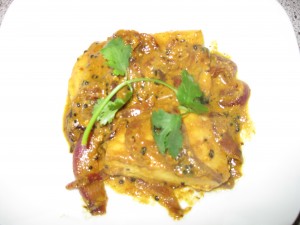
Now that I’ve removed my tongue from my cheek, here’s the totally fake (because I faked some of the typical preparation) Bengali Fish Curry I made earlier this week. @HiroBoga, this one’s for you.
Shonali’s Totally Fake Bengali Fish Curry (serves 2)
Ingredients
Any “white” fish (I used cod), de-boned; 1 tbsp cooking oil (Bongs would use mustard oil); 1 large red onion, sliced (if I’d done this right, I’d have ground and made it into a paste); 1 tbsp black (not yellow) mustard seeds; 1 ½ tsp ginger paste; 1 tsp coriander powder; ½ tsp turmeric powder; ½ cup plain nonfat yogurt; salt to taste.
Recipe
Heat oil until it’s smoking in a large nonstick pan, then reduce heat to medium. Add mustard seeds (they should start crackling instantly). After a couple of seconds, add onions (or paste), and stir frequently until brown (but not burnt). Add ginger paste, cook for a few seconds, then add coriander, turmeric and salt. Mix well and after a couple of minutes, add the fish, turning gently and coating well with the gravy.
In a small bowl, beat the yogurt with a spoon until there are no lumps. Reducing heat to medium-low, stir yogurt into fish and mix well, taking care not to break the fish. Cover with a lid so that the fish gets cooked, turning once; it should only take a few minutes.
And that’s it. Quick and easy, huh? Goes great with steamed rice and your vegetable of choice.
Notes: It’s really important to get the oil smoking hot so that when you put in the mustard seeds, they cook instantly. Once you add the yogurt, make sure the heat is turned down to medium-low so that it doesn’t curdle. Yogurt’s a great way to add a mellow gravy to almost any Indian dish, by the way, so try it with your other favorite recipes.
Filed under Cooking, Recipe of the Week | Tags: bengali food, Cooking, food, hiro boga, recipes | Comments (9)Is Your PR Better Than Broccoli?
Ode to Brassica
PR lessons can come from the strangest places. Now, I’m not going to create a laundry list, but as I was cooking dinner last night, the broccoli florets that I was steaming looked me square in the face and said: “Is your PR as good as we are?”
At first glance, broccoli’s a pretty unprepossessing vegetable. Its scientific name, brassica oleracea, is enough to give one hiccups. It’s not elegant or neat, like asparagus. And its color, while not unpleasing, doesn’t exactly shout out for attention, like that of a tomato.
Yet broccoli’s one of the most popular vegetables in the world today. Why? Because it’s easy to cook and is packed full of nutrients. You don’t have to do much to broccoli to derive its benefits. It’s not hard to find, deeply satisfying and delivers its goods quickly and directly. Broccoli simply – is.
Good PR’s much like broccoli.
Think about it. Good PR doesn’t get lost in semantics, and can work without the bells and whistles we so often want to dress it up in. It focuses on measurable objectives and outcomes, rather than hiding behind outputs. And it adapts to the changing needs, and technologies, of our times.
With new buzz words and phrases being born every day, perhaps it’s time to go back to the basics, and remember what PR is really about, and what takes it from average to good or, even better, great.
So, is your PR better than broccoli?